

組織再生制御学講演会を開催しました
2026年1月22日(木)18:00〜19:30
徳島大学歯学部3階 講堂
岩本 勉 先生
東京科学大学大学院医歯学総合研究科
小児歯科学・障害者歯科学分野 教授
【演題】歯の発生の理解とその応用を目指した細胞外環境が司る細胞分化制御機構
細胞外における物理的・化学的環境が、歯の硬組織発生にいかに関与するかについて、大変示唆に富むご講演をしていただきました。各研究には随所に創意工夫が凝らされており、きわめて独創的であると深い感銘を受けました。当日は多くの研究者が参加し、活発な質疑応答が行われました。岩本先生、誠にありがとうございました。

徳島大学大学院・医歯薬学研究部・組織再生制御学分野・講師 加納史也 先生
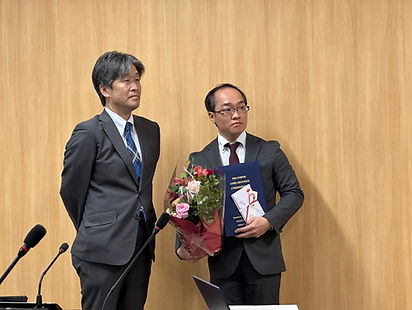
高田 充 歯科基礎医学奨励賞受賞 ㊗️🎉受賞日 2025年12月11日(木)
徳島大学大学院医歯薬学研究部歯学域基礎歯学系研究分野に所属する大学院生または若手研究者のうち、優れた研究業績を挙げ、将来、歯科基礎医学研究者としての活躍が期待される者に授与されました。
徳島大学大学院・医歯薬学研究部・口腔科学研究科 博士課程終了 2025年10月25日
徐 陽 先生(Xu Yang)博士 ㊗️🎉😭

学位論文:Xu, Y. et al. Conditioned medium from stem cells of human exfoliated deciduous teeth ameliorates mouse ovalbumin-specific allergic dermatitis. Stem Cell Res. Ther. 16, 605 (2025).
Atopic dermatitis (AD) involves chronic inflammation and barrier dysfunction. This study evaluated SHED-CM in an OVA-induced AD-like mouse model. Intravenous SHED-CM markedly reduced dermatitis severity, improved epidermal structure, and restored filaggrin. SHED-CM promoted Treg differentiation while suppressing Th2/Th17 responses, B cell maturation, antigen-specific IgE production, and mast cell activation. SHED-CM directly induced Treg differentiation from naïve CD4⁺ T cells via TGFβ, with minimal effects on Th1, Th2, or Th17 differentiation. These findings highlight SHED-CM as a promising immunomodulatory therapy for AD.
徳島大学大学院・医歯薬学研究部・口腔科学研究科 博士課程終了 2025年3月25日
丁 程(Ding Cheng)博士 ㊗️🎉😭
学位論文:Factors secreted from the stem cells of human exfoliated deciduous teeth inhibit osteoclastogenesis through the activation of the endogenous antioxidant system.
J. Oral Biosci. 67, 100618 (2025).
Reactive oxygen species (ROS) induced by RANKL play a critical role in osteoclast formation. In this study, we demonstrated that SHED (stem cells from human exfoliated deciduous teeth) strongly suppress ROS production, thereby inhibiting osteoclast differentiation. Furthermore, comprehensive proteomic analysis identified seven secreted factors from SHED that suppress RANKL-induced ROS generation.

徳島大学大学院・医歯薬学研究部・組織再生制御学分野・助教 加納史也 先生
「第6回若手口腔外科学会優秀論文賞」受賞 ㊗️🎉
受賞日 2024年11月22日 第69回公益社団法人日本口腔外科学会総会・学術大会


Radiation therapy for head and neck cancer adversely affects the surrounding normal tissues. Damage to the radiation-sensitive acinar cells of the salivary glands causes severe radiation-induced xerostomia (RIX), for which no effective treatments currently exist. This study investigated the therapeutic effects of serum-free conditioned medium from stem cells of human exfoliated deciduous teeth (SHED-CM) in a mouse model of RIX. SHED-CM prevented radiation-induced skin ulceration and preserved salivary gland function. Furthermore, SHED-CM protected salivary gland cells from radiation-induced oxidative stress by promoting the expression of antioxidant enzymes. These findings suggest that SHED-CM therapy may represent a promising therapeutic approach for RIX.
徳島大学大学院 口腔科学研究科 徐 陽 先生
第23回日本再生医療学会総会 「優秀演題賞」受賞 ㊗️🎉
Conditioned medium from stem cells of human exfoliated deciduous teeth ameliorates atopic dermatitis
2024年3月21日(木)~23日(土)新潟朱鷺メッセ

Conditioned Medium From Stem Cells of Human Exfoliated Deciduous Teeth Alleviates Mouse Osteoarthritis by Inducing sFRP1-Expressing M2 Macrophages
Linze Xia and others: Stem Cells Translational Medicine, https://doi.org/10.1093/stcltm/szae006


We found that administration of conditioned medium from stem cells of human exfoliated deciduous teeth (SHED-CM) to a mouse model of temporomandibular joint osteoarthritis (TMJOA), induced by forced mouth opening, suppressed osteochondral damage through the induction of tissue-repairing M2 macrophages. When M2 macrophage–derived conditioned medium (M2-CM) was administered to TMJOA mice, inflammatory responses and matrix degradation in the cartilage were attenuated, whereas chondrocyte proliferation and cartilage matrix regeneration were promoted. Furthermore, proteomic analysis revealed that secreted frizzled-related protein 1 (sFRP1), a Wnt signaling antagonist, is a major therapeutic factor contained in M2-CM. This study provides insights that may contribute to the development of minimally invasive joint regeneration therapies using autologous peripheral blood–derived macrophages.